Published on: 28/11/2025
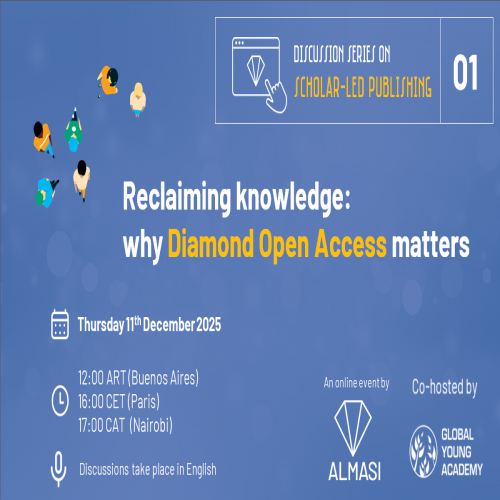
Reclaiming knowledge: why Diamond Open Access matters
11th December 2025 at 16:00 CET (Paris)
This webinar explores the future of scholarly communication by bringing together perspectives from Europe, Latin America, and Africa to examine how Diamond Open Access can contribute to a more equitable and community-driven publishing ecosystem. The session examines the limitations of commercial publishing, particularly how APC-based systems restrict participation and shape research assessment. It introduces the key legal and rights-related principles that support public-good publishing, including rights retention and community governance. Drawing on experiences from regions with limited resources, the webinar illustrates how Diamond Open Access can reduce financial barriers, broaden participation, and help researchers maintain ownership of their work, ultimately supporting stronger and more inclusive research communities. Overall, the webinar demonstrates how community-owned, non-profit publishing models can support a more inclusive, transparent, and globally responsive scholarly communication system, and why they are increasingly important for the reform of research evaluation and the advancement of Open Science.
Programme
- European Perspective: Scientific knowledge and the public good: Rights, responsibilities and community-driven governance
Ginevra Peruginelli | Institute of Legal Informatics and Judicial Systems (IGSG-CNR)
More information
Ginevra Peruginelli is a Senior Researcher at the Institute of Legal Informatics and Judicial Systems (IGSG-CNR), Florence. Her research focuses on open access to legal information, copyright and authors’ rights, evaluation of legal scholarship, and multilingual legal information retrieval. She has participated in several European and national projects (i.e. DIAMAS, Right2Pub, SPRING), addressing open access publishing models, rights retention, and research dissemination. She is an active member of the Free Access to Law Movement, an international coalition of legal information institutes (LIIs) promoting free, open, and public access to legal information worldwide and takes part in ENRESSH, the international network for research evaluation in the Social Sciences and Humanities.
- Latin American Perspective: Diversifying candidate profiles to tackle complex societal problems: The Role of Non-Commercial publishing
Luciana Balboa | INBIRS (University of Buenos Aires-CONICET)
More information
Dr. Luciana Balboa is an Infectious Diseases researcher at INBIRS (University of Buenos Aires-CONICET) and an Immunology professor at UBA’s School of Medicine. Her team advances understanding of the immune response to Mycobacterium tuberculosis, the pathogen behind tuberculosis. A pioneer in global collaboration, she established the first French-Argentine International Associate Laboratory focused on tuberculosis/HIV co-infection. As a member of the Global Young Academy and a board member of CoARA, she drives the global adoption of innovative research assessment practices, championing systemic change in how scientific excellence is evaluated.
- African Perspective: Opening the Gates: Building a Fairer Global Publishing System Through Diamond Access
Dr. Philip Mwachaka | Editor-in-Chief of the East African Journal of Neurological Sciences
More information
Dr. Philip Mwachaka is the Editor-in-Chief of the East African Journal of Neurological Sciences, a Diamond Open Access journal advancing scholarship in neurosurgery, neurology, neuroscience, and brain health across the African region. He is a neurosurgeon and academic faculty member committed to strengthening equitable research dissemination and reducing the structural barriers faced by researchers in low- and middle-income settings. Dr. Mwachaka is a strong advocate for community-owned, non-profit publishing models that enable African researchers to share their work freely, retain control over their intellectual outputs, and meaningfully contribute to global scientific dialogue. Through his leadership of the East African Journal of Neurological Sciences, he has championed initiatives that expand Oopen Sscience, build editorial and research capacity, and amplify African scholarship. He participates actively in regional and international conversations on Diamond Open Access and equitable scholarly communication.
>> Discussions take place in English